Strategy
AEO: What Answer Engines Change About Ranking in the Local Map Pack
AEO is changing how local businesses get found before they ever reach Google's map pack. Here's what's actually different and what to do about it.
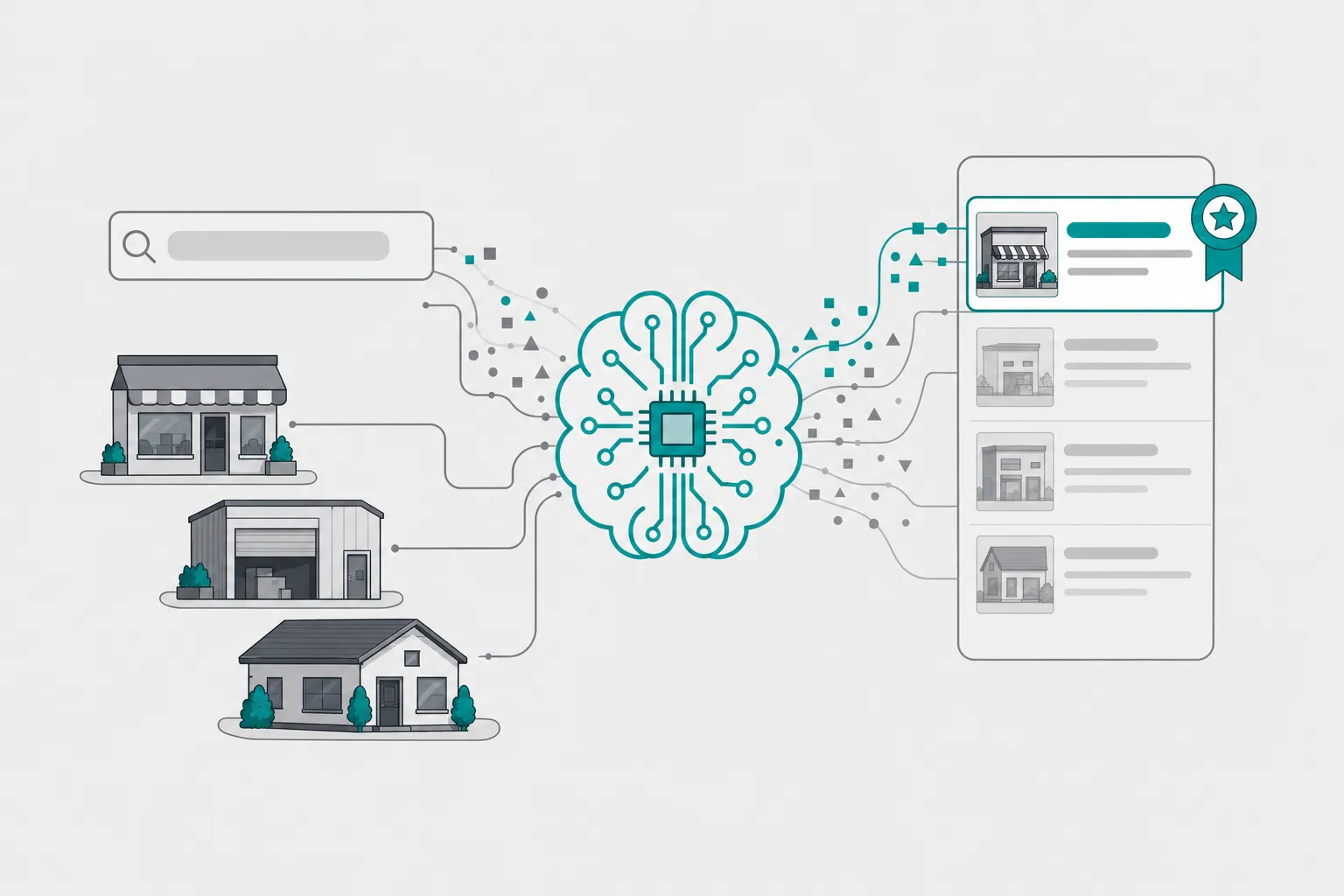
AEO — answer engine optimization — is the term people now use for making sure ChatGPT, Perplexity, and Google’s AI Overviews can name your business correctly when someone asks a question instead of typing a search query. It is not a rebrand of SEO and it is not a replacement for it. It is a separate layer that sits next to the map pack, and most local businesses have no idea whether they show up in it at all.
Here is the practical difference. A homeowner used to type “plumber near me” into Google, look at the three listings in the map pack, and call one. Now a growing share of that same homeowner types “who’s a reliable plumber in Hamilton for a burst pipe” into ChatGPT, or asks Google’s AI Overview the same thing, and gets a written answer with one or two businesses named in it — sometimes with no map, no ranking, no click required at all. If your business isn’t structured in a way these systems can read and cite, you don’t lose a ranking. You simply never enter the conversation.
What AEO Actually Means (And Why It Isn’t Replacing SEO)
AEO is about being citable, not just rankable. Search engines rank pages against a query and show ten blue links. Answer engines read content, extract facts, and generate a direct answer — often naming two or three sources by name. The mechanics are different:
- SEO rewards relevance, backlinks, page speed, and keyword match against a search query.
- AEO rewards structured, unambiguous, fact-dense content that an AI model can lift cleanly: your service area, your hours, your pricing model, your specialties, stated in plain language rather than buried in marketing copy.
The two aren’t competing disciplines. A well-built SEO foundation — clean site structure, accurate schema markup, a Google Business Profile that’s actually maintained — is also what AI systems draw from. Businesses treating AEO as some separate tactic to bolt on are missing that it’s mostly the same underlying work, done with more precision. Our SEO & AI search services exist specifically because these two things now have to be built together, not sequenced.
How the Local Map Pack Still Works — and What’s Different Around It
The map pack itself hasn’t fundamentally changed. Google still weighs proximity, relevance, and prominence — and prominence still comes largely from review volume, review recency, citation consistency, and a Google Business Profile that’s filled in completely and updated regularly. If you haven’t touched your GBP posts, Q&A section, or photos in eight months, that’s still costing you inside the map pack, independent of anything AI-related.
What’s different is what sits above and beside the map pack. Google’s AI Overviews now appear on a meaningful share of local queries before the map pack even loads, and they’re built from a mix of your website content, your GBP data, and third-party mentions — review sites, directories, local news, association listings. If those sources disagree on your hours, your service area, or even the spelling of your business name, the AI Overview either picks the wrong one or leaves you out to avoid the conflict. Map pack ranking has always rewarded consistency. AEO punishes inconsistency harder, because there’s no human scanning three listings and using judgment — there’s a model choosing what to state as fact.
This is the same work covered under local SEO and Google Business Profile management, but the standard for accuracy just got higher. A profile that’s “mostly right” used to be good enough to rank. It’s no longer good enough to get cited.
Where ChatGPT and Perplexity Actually Pull Your Business Information From
This is the part most business owners skip past. ChatGPT and Perplexity don’t crawl the live web the way Google’s index does. They rely heavily on a smaller set of trusted, structured sources: your own website (if it has clear service pages and schema markup), review platforms with volume and recency, Wikipedia and industry directories where applicable, and increasingly, Google’s own indexed data. If your website is a single homepage with a paragraph of vague copy and no dedicated pages for what you actually do, there’s almost nothing for these models to extract with confidence. They’ll cite a competitor with a thin but structured site over you with a better business and a worse one.
Concretely, that means:
- A dedicated page per service, not one page trying to cover everything.
- Schema markup that states your service area, pricing model (even a range), and business type in code the model can parse, not just prose a human reads.
- Reviews that mention specifics — the service performed, the neighbourhood, the outcome — because generic five-star reviews carry less extractable information than one that says “replaced our furnace in Grimsby within a day.”
- Consistent name, address, and phone number across every directory you appear in, because conflicting data is the single most common reason a business gets excluded from an AI-generated answer rather than just ranked lower.
The Overlap Between AEO and Local SEO, and Where They Split
Most of the groundwork is shared. A business with strong local SEO — accurate GBP, consistent citations, service pages instead of one thin homepage, genuine review volume — is already 70 to 80 percent of the way to being AI-citable. The split happens in a few specific places:
- Structure over keywords. SEO still rewards matching search intent with the right phrasing. AEO cares less about phrasing and more about whether a fact is stated plainly and once, unambiguously, somewhere a model can find it.
- Third-party corroboration matters more. Google can rank your own claims about yourself. AI answer engines weight what other sources say about you — reviews, directories, press mentions — more heavily, because a model treats a claim repeated across independent sources as more reliable than a claim made once on your own site.
- There’s no ranking position to chase. You either get named in an AI answer or you don’t. There’s no page two. That makes the cost of being wrong — outdated hours, an old service area, a defunct phone number — much higher than it was when you could still show up at position seven.
What Ignoring This Costs a Local Business
We don’t have a published number for cost-per-lead lost to AI answer exclusion — nobody credible does yet, because the behaviour is still shifting month to month. What we do know, from tracking cost per issued appointment across live campaigns, is that the businesses losing ground aren’t losing it to a competitor with a better trade reputation. They’re losing it to a competitor with a cleaner, more structured digital footprint that happens to answer the question a model is trying to answer. That’s a fixable gap, not a permanent disadvantage — but it doesn’t close itself, and it’s not solved by spending more on ads while the underlying information about your business stays messy or thin.
Fixing conversion and discoverability before increasing spend is the same principle whether the channel is a paid ad, an organic search result, or an AI-generated answer. If the foundation is wrong, more traffic just means more people arriving at the wrong information faster.
What to Fix This Month
- Audit your NAP consistency. Search your business name and check that your hours, address, and phone number match across your website, Google Business Profile, and the top three directories you appear in.
- Ask ChatGPT and Perplexity about your own business. Type the question a customer would ask — not your business name, the actual question — and see what comes back. If it’s wrong, incomplete, or names a competitor instead, you have a concrete list of what to fix.
- Build or fix service-specific pages. If your website has one page trying to describe everything you do, split it. Structured, specific pages are what both Google’s index and AI models can actually extract facts from.
- Push for specific reviews. Ask customers to mention what was done and where, not just that they’re happy. It costs nothing and it’s the raw material both the map pack and AI answers are drawing from.
None of this requires a platform migration or a six-figure retainer. It requires someone treating your discoverability as infrastructure, not an afterthought — which is the same standard we hold the rest of a client’s system to, from the website and ads to the CRM that follows up on the lead.
If you want a straight answer on where your business currently stands — in Google’s map pack and inside AI-generated answers — get a free AI online assessment. We’ll show you exactly what ChatGPT, Perplexity, and Google’s AI Overviews currently say about your business, and what’s missing.