Strategy
How AI Search Answers Use Your Website Content Now That Google Breaks Every Query Apart
Google's query fan-out went production-ready Sept. 24, 2026. Here's how AI search answers use your website content now, and a 10-question test for your site.
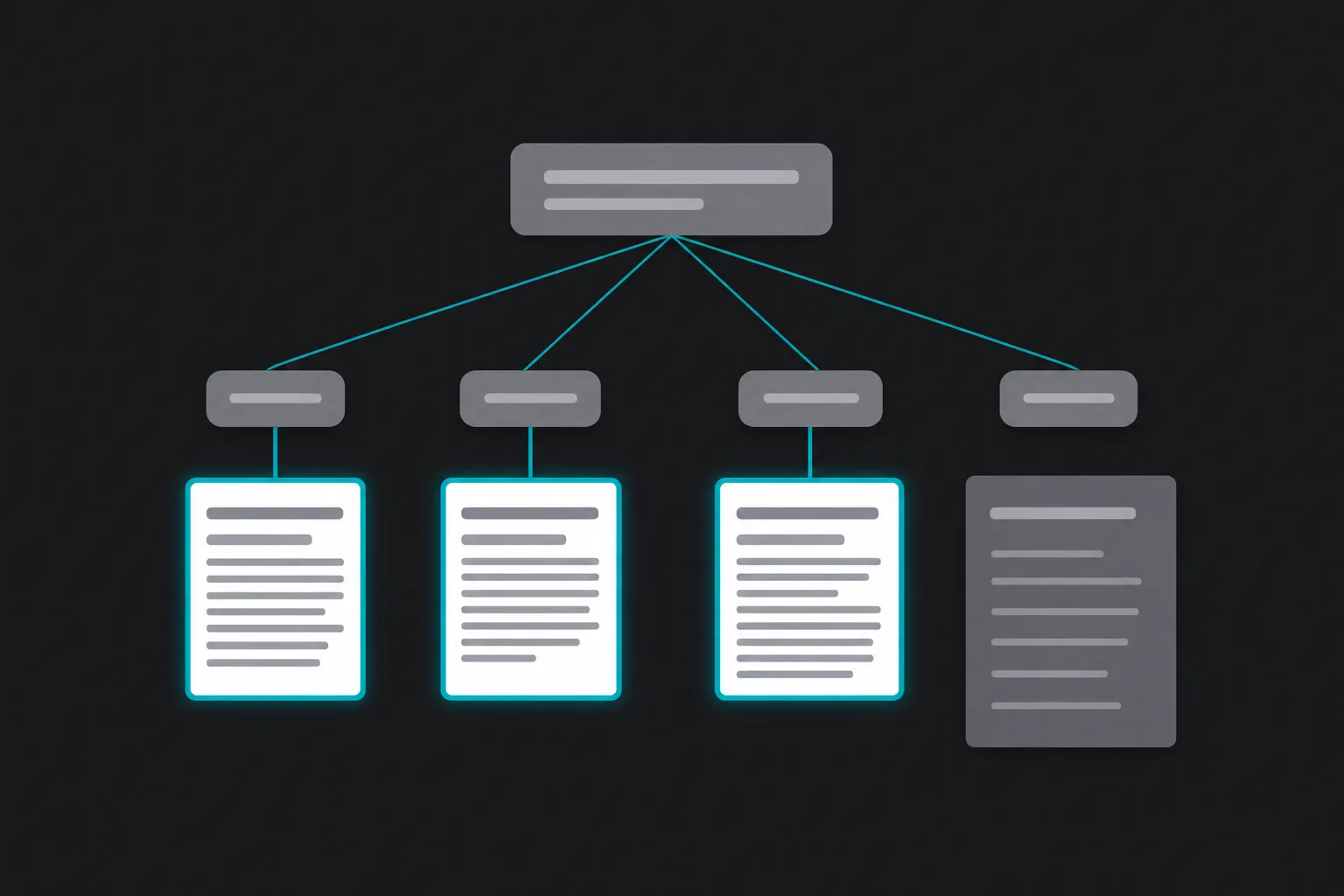
On September 24, 2026, Google confirmed that query fan-out is now a production-ready part of how it generates AI Overviews and AI Mode answers. That sounds like a technical footnote. It isn’t. It changes how AI search answers use your website content, and it means a lot of service pages that were built to rank for a broad keyword are now competing against pages they were never built to beat.
What changed on September 24, 2026
Google has talked about query fan-out in research papers and developer sessions for a couple of years. What changed on that date is that it moved from experimental to how a meaningful share of searches are actually processed. Instead of matching your search to the single best page, Google’s AI layer breaks your question into several smaller questions, sends each one out to retrieve answers, and stitches the results into one response.
If you run a business that depends on getting found when someone searches for help, this is not a future problem. It is already shaping what shows up above the traditional blue links today, and it will keep expanding through 2026 and into 2027 as more query types get routed this way.
Google query fan-out, explained plainly
Here’s the mechanism without the jargon. A person searches “furnace making a clicking noise and shutting off.” Instead of treating that as one query, Google’s AI system fans it out into several implied sub-questions: What causes a furnace to short cycle? Is a clicking noise before shutdown dangerous? Is this a DIY fix or a service call? What does an emergency furnace repair cost after hours?
Each of those sub-questions gets its own retrieval pass. Google pulls whatever page, anywhere on the web, answers that specific piece best, then assembles the pieces into one AI Overview. Your business doesn’t need to win one search. It needs to win pieces of several searches that happen inside a single user’s question, sometimes within the same few seconds.
This is the part most agencies still aren’t explaining to clients: fan-out means you’re no longer competing page-for-page against other businesses in your city. You’re competing section-for-section against whoever wrote the clearest paragraph on short cycling, whoever published actual after-hours pricing, and whoever structured their page so a machine could lift the answer cleanly.
How AI search answers use your website content
This is the question owners actually need answered: how do AI search answers use your website content once it’s fanned out into pieces? Three ways, and they’re different from how classic Google ranking worked.
- Extraction, not ranking. The AI layer isn’t deciding which page deserves the top spot. It’s lifting a specific sentence or block that directly answers one sub-query, regardless of whether that page ranks first, fifth, or isn’t in the top ten for the broad keyword at all.
- Preference for self-contained answers. A paragraph that states the cause, the fix, and the cost in plain language gets pulled more reliably than a paragraph that requires the reader to keep scrolling for context. Vague, promotional language gets skipped because there’s nothing concrete to extract.
- Citation across multiple sources. One AI Overview can cite three or four different businesses for three or four different pieces of the same answer. You’re not fighting for an exclusive win. You’re fighting to be one of the sources that gets named, because being named is what drives the click.
That third point is also how you get cited in ChatGPT and other AI search tools, not just Google’s own overviews. The underlying behaviour is similar: these systems retrieve and synthesize from pages that answer a specific question cleanly, with enough structure that the system can trust the content is accurate and attributable to a real business.
Why “Furnace Repair Hamilton” loses to the specific question
Picture the page most HVAC companies have had on their site for a decade: a service page titled “Furnace Repair Hamilton,” with a few hundred words about reliability, experience, and a contact form. It was built for 2019 search, when ranking for the head keyword was most of the job.
In a fan-out world, that page is competing against a business that has a page directly titled, in effect, “why does my furnace short cycle in winter” with a clear three-paragraph answer, and a separate page answering “how much does an emergency furnace repair cost after hours” with an actual number or range. The broad page never gets a chance to compete, because the query never arrives as “furnace repair Hamilton” in the AI layer. It arrives as four or five specific sub-questions, and the broad page doesn’t answer any of them directly enough to get pulled.
This isn’t unique to HVAC. A physiotherapy clinic with a page titled “Physiotherapy Services” is losing pieces of fanned-out queries to a clinic with a page answering “how long after a knee replacement can I start physio” or “is dry needling covered by insurance in Ontario.” A roofing company’s “Roof Repair” page is losing to whoever answers “how do I know if my roof leak is from flashing or shingles” with photos and a direct explanation.
The phone test: pull your last 10 customer questions
Here’s a test any owner can run this week without hiring anyone. Pull the last ten questions a customer actually asked on the phone, in a quote conversation, or in an email before they booked. Not the questions you assume they ask. The actual words they used.
Then open your website and check: does any page answer that specific question directly, in a block of text that could stand on its own if someone only read that paragraph? Not “is it covered somewhere in the service page copy.” Directly, with the kind of specificity you’d give the customer on the phone.
Most businesses we look at pass this test for zero or one of the ten questions. The website answers “what do you do” reasonably well. It almost never answers “how much,” “how long,” “is this an emergency,” or “will this be covered,” which are the exact sub-queries fan-out is built to isolate and route.
Structured content for local service businesses: what the fix looks like
The fix isn’t a redesign and it isn’t throwing out your service pages. It’s adding the layer underneath them that was missing. For structured content for local service businesses, that typically means:
- A set of pages or sections, each built around one real customer question, with a direct answer in the first two or three sentences.
- Specific numbers where you can state them. Price ranges, timeframes, what’s included. Vague language doesn’t get extracted; specifics do.
- Clear markup (schema, headings, FAQ structure) so machines can parse what’s a question and what’s an answer, not just what’s on the page.
- Local and service-specific detail that a national competitor’s generic content doesn’t have, because fan-out often routes local sub-queries to sources that actually demonstrate local knowledge.
This is also where consistency matters more than people expect. If your Google Business Profile, your website, and your directory listings disagree on hours, service area, or pricing structure, that inconsistency makes it harder for any AI system to cite you with confidence. Our local SEO and Google Business Profile work and our broader SEO and AI search services are built around this exact problem: getting the structure and the facts aligned so a business shows up accurately, not just more often.
What this means if you’re a contractor, clinic, or quoted-work business
AI search visibility for contractors looks different than it does for an e-commerce brand, and that’s worth saying plainly because a lot of generic SEO advice doesn’t account for it. Your customers aren’t comparing product listings. They’re trying to figure out if something is urgent, what it will roughly cost, and whether you’re the kind of business that actually knows their specific situation. Those are the sub-queries fan-out is isolating.
The same logic applies to clinics answering insurance and eligibility questions, to home improvement companies answering material and timeline questions, and to professional services firms answering scope and cost-structure questions. In every case, the businesses that win pieces of the fanned-out query are the ones that already wrote the answer down somewhere a machine can find it cleanly.
None of this replaces the fundamentals. You still need a site that loads fast, a Google Business Profile that’s accurate, and reviews that reflect real work. Fan-out doesn’t make SEO obsolete. It changes what good SEO has to include.
What to do this month
Run the phone test this week. If your site answers fewer than half of your real customer questions directly, that’s the gap worth closing before you spend another dollar on ads pointed at pages that can’t convert that traffic anyway. Fixing conversion and content structure comes before increasing spend, not after.
If you want a second set of eyes on where the gaps are, get a free marketing audit to see whether your site is actually structured to answer the questions AI search is breaking your customers’ queries into. You can also read more about how we approach this on our about page or see the full picture of how we connect this work to paid search and lead follow-up on the services overview.